
 Deutsch
ROVER 3 hp
Operating
1904 - 1906
The ROVER catalogues of the early years contain extensive instructions for the operation of the motorcycles. No wonder, because there was no general literature on the use of motorcycles - the distribution of controls differed from manufacturer to manufacturer, in some cases even from model to model. Further standardization of both the controls and their arrangement has only been achieved over the years.
Instructions for operating the Imperial ROVER motorcycles
Before Starting
Fill the petrol tank through the petrol neck. Petrol of ‘68o, or thereabouts, specific gravity, should be used. Strain the petrol through fine gauze when filling tank.
Fill the lubricating oil tank, through the neck marked on the same diagram, with the best lubricating oil specially prepared for air-cooled motors. No Other Oil Will be satisfactory.
Inject a measure of lubricating oil into the engine by raising the tap of the lubricating pump to the horizontal position, drawing up the plunger until the pump is seen to be full; then turn the tap to the vertical position and depress the plunger. Raise the tap again at once.
Unscrew the needle valve two half-turns, and push down the tap underneath the tank, whereby petrol will flow through the copper pipe to the carburetter.
Draw the ignition lever (right hand) back to retard the spark.
Place the throttle valve lever (left hand) to a ertical position.
Switch on the current by pushing the lever of the two-way switch to one side. It is best to make a practice of always pushing this lever to the same side, say number one, so as to use one accumulator before the other, thus keeping the second accumulator fully charged in reserve.
When running machine on the stand see that the backpedalling brake is kept out of action.
To Start
Grasp the handles and raise the exhaust valve by means of the lever on the left handle.
Mount the cycle, pedal forward, and when under way release the exhaust valve lever, whereupon the engine will start working.
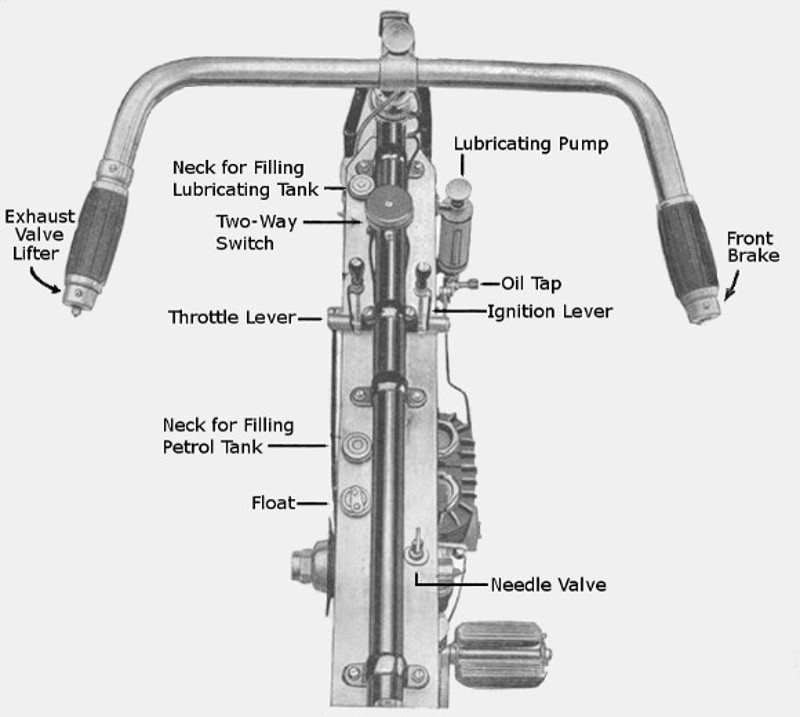 Controls Model 1904 - The two-way switch is still on the top tube, the fuel level indicator (via float) is still separate.
Riding Hints
Regulate the pace by means of the throttle and ignition levers. It is economical and to the advantage of the engine to use as little gas as possible.
For speed, push the ignition lever forward gradually.
Up-hill, push the throttle forward, and if the pace drops, draw the ignition lever slowly backward so that it is never too far forward for the speed.The Belt
This should be neither too tight nor too slack; if the former, undue wear will be placed upon the bearings; if the latter, the belt will be liable to slip over the engine pulley, so that the engine will not be started, or the belt will slip so that the engine will race up hill without propelling the machine. In this event, the belt must be slipped off the pulleys, a short piece cut out, and the ends rejoined.
The belt should be kept clean and supple by means of the occasional use of belt dressing supplied by all belt makers.
Lubricating
Lubricate the engine about once in every twenty miles. Excessive lubrication must be avoided, but insufficient lubrication must be guarded against with even greater care, especially at first, lest the bearings should run dry and the engine seize.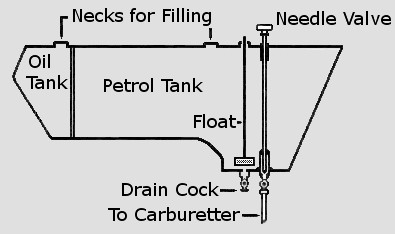
Check petrol level
The quantity of petrol in the tank can always be ascertained by opening the cap oi the float, whereupon the wire will rise, indicating the level of petrol in the tank.
Down hill
When running down hill, or at any time when it is desired to arrest the engine's impulses, the lever under the left handle can be raised. This will keep the exhaust valve open, and the current can be cut off at the switch. The raising of the exhaust valve is beneficial by cooling the engine.
To Stop
Both brakes should be applied evenly.
After a Ride
When putting the machine away, or when dismounting for more than a minute or two, always switch off the current by moving the lever of the two-way switch to the central position; turn off the tap under the tank, and screw down the needle valve to prevent waste of petrol.
The Paraffin Valve
This is fitted in the cylinder head to permit a charge of paraffin to be injected into the cylinder upon putting the machine away after a ride or before starting the machine after it has been standing. Its obiect is to cleanse the cylinder and piston rings from the congealed oil which is liable to form, especially in cold weather, so as to make the motor difficult to start, in which case the charge of paraffin injected will dissolve the oil and make the motor work smoothly.
An excess of paraffin should be guarded against, as it is liable to foul the valves and sparking plugs.
Tool Bag
The motor cycle should never be ridden without a tool-bag containing an adequate supply of all the tools necessary to enable the rider to take down any part of the motor.
Cautions
Never lay the machine flat or turn it upside down unless tanks are emptied and the accumulators removed.
Customers are warned against purchasing cheap parts, such as accumulators, coils, and sparking plugs. Failures as a rule proceed from the ignition. Nor is it economical to use an accumulator as long as it will produce any sort of spark; if an accumulator be run below 3-8 volts it may be permanently injured. As soon as one accumulator shows signs of weakening, the other accumulator should be switched on until the first can be recharged.
Please Note
Strain the petrol through fine gauze when filling tank.
Test your accumulators frequently with a volt meter. They should never be worked below 3.8 volts.
Lubricate all bearings frequently, not forgetting contact maker and free-wheel clutch.
Examine electric wire terminals occasionally, making sure the contacts are clear and tight.
Clean the belt or chain after a ride in wet or muddy weather.
Turn off the petrol and switch off the electric current at the end of a journey.
Drain used oil from bottom.
Interfere with trembler or coil when spark fails, unless it has been first ascertained that all other electrical parts are in order.
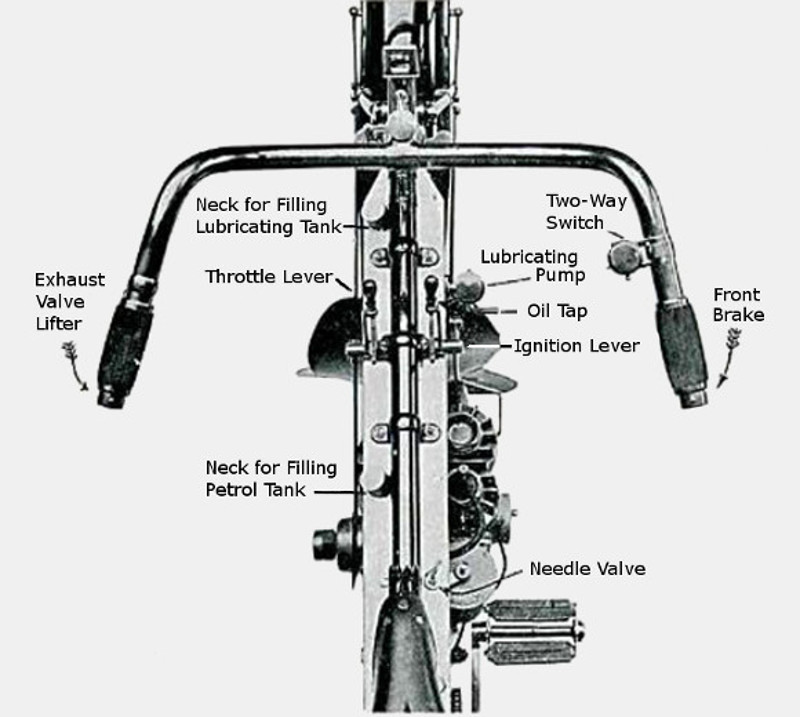 Controls Model 1905 - The two-way switch is now located on the right handlebar, the fuel level indicator (via float) is integrated in the filler neck.
© 2021-2026 by ROVER - Passion / Michael-Peter Börsig