
 Deutsch
ROVER P6/P6B
Technology - Safety Aspects
1963 - 1977
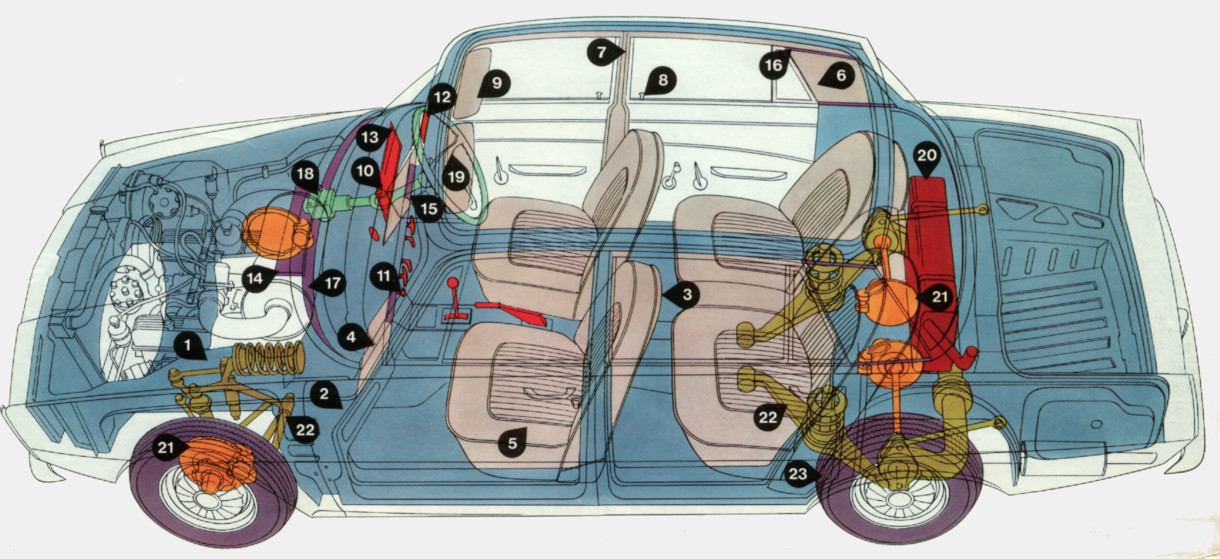
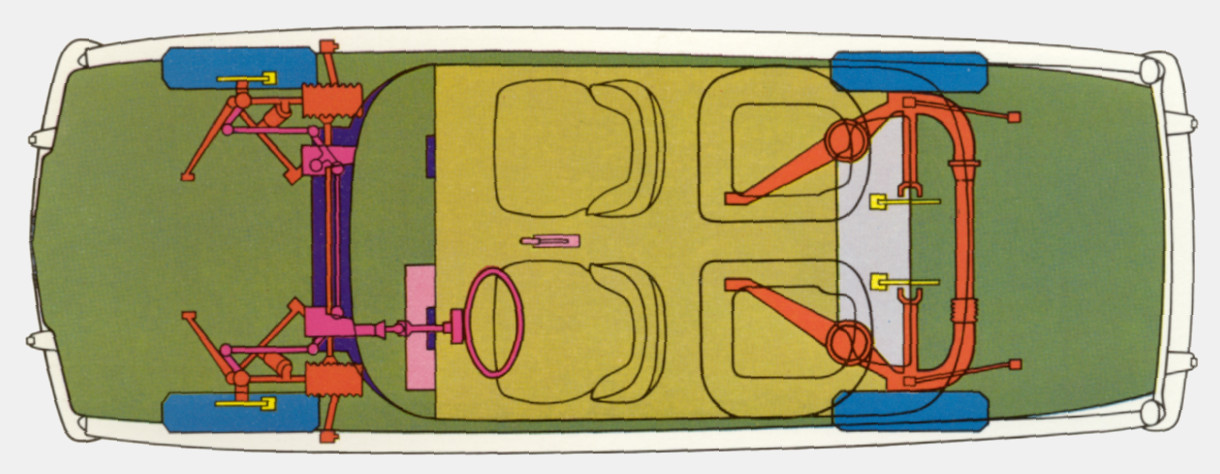
| Note on the table of safety components | ||
|---|---|---|
| The figures correspond to those of upper image. | ||
| The color markings correspond to those of the below image. | ||
| Base Unit | ||
| 1 | The base unit method of construction makes it possible to locate the passenger compartment within, what is in effect, a robust steel cage designed to resist distortion and protect the occupants. | |
| 2 | The steel bulkhead, moreover, is designed to prevent the engine penetrating to the passenger compartment in the event of a head.on collision. | |
| Interior Furnishing | ||
| 3 | The front seats have a padded roll along the top edge of the back to lessen the likelihood of head injuries to rear seat passengers thrown forward in a collision. In the event of rear impact the seat squab will also ‚give‘ rearwards thus minimising risk of neck injuries. | |
| 4 | The glove lockers positioned at knee height have a flat padded surface backed by a material which will collapse in the event of impact, thereby affording protection to the knees. | |
| 5 | The seats are designed on the basis of good medical advice to give support to the small of the back and have an infinite rake adjustment. | |
| 6 | Vital areas of the roof and rear quarter panels are fitted with thick resilient padding. | |
| 7 | Provision for inertia reel safety harness, on front seats, in addition to standard provisions. | |
| 8 | The rear door lock interior handle cannot be opened when the sill-button is depressed to minimise accidential opening of the door by a child. The door can still be opened from inside in an emergency. Anti-burst locks are fitted to all four doors. | |
| 9 | The two sun visors are softly padded and will collapse on impact. | |
| Controls | ||
| 10 | Instruments mounted close to normal line of vision to reduce visual adjustment when driver refocuses from road to instruments. (Many peaple have difficulty refocusing rapidly.) | |
| 11 | Smoothly rounded switches are designed to minimise injury and are clearly marked for quick recognition. | |
| 12 | Interior mirror fitted with protective frame. | |
| 13 | „BRAKE“ shows on instrument panel when brake fluid reservoir is low or handbrake is on. There is also a tell-tale light to indicate brake pad wear. | |
| 14 | Hazard warning switch operates all exterior flashers simultaneously, to warn other traffic of unscheduled hold-up. The switch stalk flashes red when on. | |
| Ventilating System | ||
| 15 | To minimise fatigue and drowsiness, the car is fitted with a through-flow ventilation system. | |
| 16 | Fresh air ducts at face level can be opened individually, regardless of heater setting. | |
| 17 | Opening rear quarter vents for additional ventilation. | |
| 18 | Air intake is above the exhaust level of other vehicles. | |
| Steering | ||
| 19 | Steering box mounted high up on the scuttle at the rear of the engine to avoid the steering column and wheel being pushed up into the passenger compartment in a head-on collision. | |
| The steering wheel is dished for safety and adjustable for the most comfortable position. | ||
| Fuel System | ||
| 20 | The fuel tank is protectively positioned within the main structure of the car and separated from the passengers by a steel bulkhead. | |
| Braking System | ||
| 21 | Servo-assisted disc brakes on all four wheels for the maximum stopping power. | |
| Suspension | ||
| 22 | .Independent suspension on the front wheels and De Dion suspension at the rear gives the car great stability and cornering power, with safety. | |
| Tyres | ||
| 23 | Radial ply tyres not only fitted as standard but included as part of the basic design. These tyres provide improved handling, precision steering response and offer better adhesion on wet surface. | |
© 2021-2026 by ROVER - Passion / Michael-Peter Börsig