
 Deutsch
ROVER 'Light Twenty'
Tests and Reports
1931
A NEW ROVER “LIGHT TWENTY”
The Motor - September 2,1930
Few announcments have been awaited with more interest than that of the Rover Co., whose policy during the past few seasons has been the subject of favourable comment on all sides. The 1931 programme is all the more interesting because it seems to set the seal of satisfaction on the company’s recent bold step in entering the 20 h.p. multi-cylinder car market with a product of moderate price. In addition to an improved Meteor model - the car to which reference has just been made - is a new “Light Twenty” incorporating a rather smaller chassis than the Meteor, but the same power-unit, clutch, gearbox, etc. The price of the new car, complete with a well-finished coachbuilt or genuine Weymann saloon body, is but £358. ...
Dealing first with the new “Light Twenty” model, it has already been indicated that the power unit is the same as the Meteor engine, but for 1931 a number of improvements have been effected in the layout of the auxiliaries. The main feature of this “Six”, such as a four-bearibng crankshaft, overhead push-rod operated valves, a full pressure lubrication system, etc., remain unaltered, likewise the bore and stroke dimensions of 72 mm and 105 mm respectively (capacity 2,565 c.c.; 19.3 h.p. R.A.C. rating). The engine suspension, however, has been altered from a three-point to a four-point type, the rear mounting remaining as in the 1930 edition, but at the front a plate has been fitted across the engine body and bolted to the chassis frame by brackets. This arrangement has facilitated the transfer of the dynamo from the rear of the unit (it was originally somewhat inaccessible) to the off side of the engine body, where it is driven by an endless V-belt in a triangular form of drive incorporating the fan spindle and crankshaft.
Another point which should be mentioned is the fact that the distributor drive has been simplified, the long vertical shaft having been dispensed with and the body of the instrument placed immediately above the crankcase; the coil is conveniently situated immediately above the distributor body. Although the induction system follows the 1930 pattern very closely, a special air heating and filtering device is now used, the air passing through a filter (or what is more commonly called a cleaner) into the overhead valve chamber and down through a vertical pipe into the intake of the Stromberg carburetter. Naturally, a certain amount of oil-mist is carried into the engine with the air so that lubrication of the valve stems, etc., is facilitated. Bohnalite aluminium pistons are employed, which, of course, incorporate special oil scraper rings. Perhaps the most outstanding innovation of all, however, concerns thew clutch, the free-members for which now consist of two dry plates with loose Ferodo rings interposed as the driving media. Pressure is supplied by nine springs spaced round the circumference of the flywheel, and the operation is effected by three toggle arms radially spaced from the thrust bearing in the centre.
A “Silent Third” Gear-box
As might be expected, the recently introduced four-speed gearbox incorporating a “silent third” is retained in much the same form as it appeared in 1930 Meteor models. The gearbox casing itself, however, is much smaller and neater in appearance than its prototype, but the constand mesh and three-speed pinions have double helical teeth and the action of engagement of the gears is he same as the existing type. Central control is used.
Suspension is by semi-elliptic springs front and rear, the latter being underslung in order to keep the build of the car as low as possible. Shock absorbers are fitted all round.
There are many interesting features in the new chassis, all of which show that the layout has been planned by practical motorists. For example, the pedals (which, by the way, are adjustable for reach) are fitted with spring-loaded felt pads in order to keep the interior of the body hermetically sealed from the inside of the bonnet. Again, lubrication of the underneath parts of the chassis is facilitated by a group of grease nipples housed on the outside of the chassis frame near the scuttle, while the layout of the front brake mechanism permits adjustment of the operating gear to be effected without it being necessary to grovel underneath the car or to use any tools.
The bodywork is splendidly finished, and despite the fact that the wheelbase and track dimensions are but 9 ft. 3 ins. and 4 ft. 2 ins. respectively, provides excellent passenger accommodation.
The coachbuilt and Weymann saloons and the sportsman’s coupé sell for £358 and the Regal edition of these types costs £380.

The new “Light Twenty” four-door saloon which sells at £358

The Sportsman’s Coupé edition of the Rover “Light Twenty”. The price is £358.
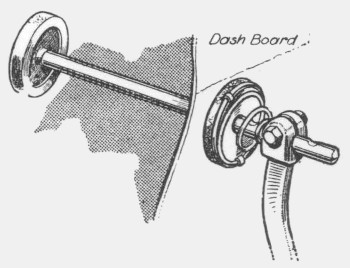
On the "Light Twenty" the pedals are fitted with spring-loaded felt pads
You can find the images in larger format
at ⇒ Coachbuilt Saloon
or at ⇒ Weymann Saloon
or at ⇒ Sportsman's Coupé
© 2021-2026 by ROVER - Passion / Michael-Peter Börsig