
 Deutsch
The history of ROVER
Biographical Data - P
Employees and associated persons
| A | B | C | D | E | F | G | H | I | J | K | L | M | N | O | P | Q | R | S | T | U | V | W | X | Y | Z |
Park, Alex
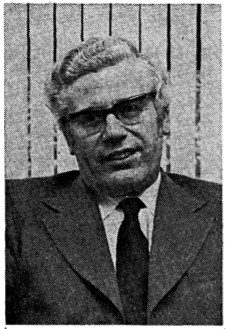 Alex Park, Director General British Leyland Ltd, picture from 1975, source: Automobil-Revue (Switzerland)
Alex Park becomes director of British Leyland Ltd (formerly British Leyland Motor Corporation, after which the name is changed to Leyland Ltd) at the age of 49 in 1975.
He is opposed to cases of protection, which are the subject of fierce debate and are intended to work against the growing imports of automobiles into Great Britain.
He sees the only chance to survive in higher quality and increased value and reliability of his own products.
Leyland depends very much on public subsidies from the tax pot at that time. The government has just provided another eight million DM for quality assurance measures (from 1975 to 1983).
On this topic he gives the Swiss Automobil-Revue 1975 an extensive interview which is very interesting.
Alex Park's career up to 1975:
Training as an engineer and accountant, specialized in finance and forecasting; head of planning at Monsanto 1957-1967; finance director at Cummings 1967-1968; finance director at Rank-Xerox 1968-1974; since January 1974 financial director British Leyland Motor Corporation (BLMC); since 24 April 1975 general director of British Leyland Ltd.
. To the order of magnitude: In 1974, British Leyland produced a total of 897,346 vehicles, including 844,230 passenger cars, 51,116 trucks and buses, 60,711 Innocenti. Turnover is 1.6 billion pounds (about 9.7 billion DM).
Park (Parkes?), John
John Park(es) is the chairman of Alvis. He proposed 1964 [ ⇒ George Farmer] a merger of Alvis and ROVER.
Alvis manufactures in small quantities high quality luxury sports cars, otherwise lives on the production of military vehicles and products.
After the merger with ROVER he became director at ROVER in 1965.
Penny, Noel
Noel Penny develops the T4 engine 2 S / 140. 1961 he is head of the gas turbine department at ROVER.
Poole, Tony
1949 Tony Poole joins ROVER as a locksmith.
After a station in the turbine department, we find him in 1956 in the construction department. He and his team are developing the interior of the Range Rover.
1968 he and [⇒ David Bache]design the driver's cab for the Leyland gas turbine truck.
Poppe, Erling
The eldest son (1898-1970) of [ ⇒ Peter August Poppe ] studied mechanical engineering in Birmingham. From 1922 to 1930 he developed motorcycles at the company Packman & Poppe. A 250 ccm two-stroke machine was followed in 1923 by a side-controlled 976 ccm machine with a JAP two-cylinder V-engine, followed by a 350 ccm "Silent Three" with Barr and Strout sleeve valve engine.
Gilmour Packman (1899-1925) was a successful motorcycle racer who tragically died in 1925 after a dispute with a salesman. In the same year the company buildings were destroyed by fire and in 1926 the company was sold to John Wooler. Until the Depression in 1930 motorcycles were manufactured..
Erling Poppe then works for White & Poppe Ltd as works manager. At this time the company belonged to Dennis Brothers, the company's former largest customer. In 1933 the production facilities of White & Poppe are moved from Coventry to new buildings of Dennis Brothers in Guildford - 2,000 tons of machinery and material by truck - and rebuilt there 1:1. Erling Poppe supervises this action and then works for Dennis Brothers as works manager.
With the single-seater sports version of the ROVER 16/50 hp developed by [ ⇒ Peter August Poppe ] he drives at over 160 km/h on the racetrack of Brooklands. A two-seater version of the same type is rated by the RAC at 134.30 km/h.
After World War II he developed the motorcycle models S7 and S8 for Sunbeam, a subsidiary of
For Vernon Industries Erling Poppe developed from 1952 the 'Vi-Car', a three-wheeled invalidity vehicle, and from 1954 the 'Gordon'. The latter belonged to the three-wheeled automobiles popular in England after World War II, which were sold mainly by price (under £300 including purchase tax). The 'Gordon' offered two seats in front, but only one door on the left side, because on the right side, almost like an outboard motor, the engine was arranged, which drove the right rear wheel via a chain. Under the bonnet only the big front wheel, the tank and the battery found place. In the rear part there were two longitudinally installed seats, reminiscent of hammocks, which were only suitable for children. A textile folding roof protected the occupants from the rigors of the weather.
Production ended in 1958. A total of several hundred copies were produced, of which only two have survived.
| Due to the scurrility we show here pictures of the 'Gordon' - no pictures of the 'Vi-Car' are known. | ||
|---|---|---|
 |
 |
 |
| A press photo of the 'Gordon' - the family is visibly happy with the vehicle. | The view shows the rather economical space of the 'Gordon' - between seats in the front and two "hammocks" in the back for the little ones. | The view on the right side of the carriage shows the position of the drive and the textile roof against the harsh weather conditions. |
Poppe, Gunnar
To complete the Poppe biographies, Gunnar Poppe (1901-1964), the second son of [ ⇒ Peter August Poppe ] should be mentioned, although he had nothing to do with ROVER.
After his studies in Cambridge he worked from 1923 to 1932 at Austin Motor Co, with the Austin 'Seven' he was successful as a racing driver. From 1932 he worked for Clement Talbot Ltd..
Poppe, Olaf
Olaf Poppe (1906-1970) is the third and youngest son of [ ⇒ Peter August Poppe ]. Little is known about his career. Also the date of his joining ROVER is unclear. What is certain is that in 1947, as chief planning engineer, he developed the production of the box frame of the Land Rover from four welded steel strips. The purchase of machines for the production of the box frame from sectional steel was simply not possible without money.
The first pre-series - Landy was completed on 24 February 1948. And Poppe's development proved so successful that by the end of Series III in 1985 all box frames of the short wheelbase models had been built using this method.
The original idea of the box frame came from [ ⇒ Adrian Lombard ], as [ ⇒ Gordon Bashford ] always stated.
Olaf Poppe is further only known to have been active in the development team for gas turbines.
Poppe, Peter August
The Norwegian Peter August Poppe (1870-1933) studied at the Horten Tekniske Skole and subsequently worked at the armoury works Kongsberg Gruppen. This turned him off to the Austrian arms factory Steyr Mannlicher. There he met Alfred James White from Coventry in 1897, who offered him to come to Coventry and build an engine factory together. In 1899 they founded the company White & Poppe Ltd, whereby the White family ensured the financing of the company. Alfred White acted as general manager, Peter August Poppe as chief developer.
During the Boer War ammunition and grenades were produced on behalf of the government. Poppe also developed engines. In 1900 he acquired numerous patents for the production machines he also designed.
In 1902 White & Poppe presented a motorcycle with a power of 5 hp and an engine with two standing cylinders.
The production of engines, transmissions and precision parts for the automotive industry was running at full speed. In 1906, 15 companies exhibited cars with W & P engines at the British International Motor Exhibition. The carburettor developed by Poppe was also widely used. In 1910, one third of the vehicles exhibited at the Olympic Show were equipped with it; it was also used for boats and airplanes.
In 1914 350 employees were employed at W & P. During World War I, the number of employees rose to over 12,000 - mainly women who worked in the additionally acquired ammunition factory National Shell Filling and Fuse Factory No. 10. From 1916, wings for airplanes were built.
1920 Alfred White sells his shares in Dennis Brothers, the largest buyer of W & P engines, but continues to run the company. Poppe also remains for the time being and also has an advisory function for Maudslay. There he meets [ ⇒ Alex Craig ], who is director of both Maudslay and ROVER. 1923 Poppe changes to ROVER, where he must quickly make the 8hp competitive. From 1924 he is chief engineer of the house, launching the ROVER 9/20hp on the market. He also brought with him the plans for the engine and the car, which will be marketed as ROVER 14/45 hp. Poppe had been working on its four-cylinder engine, originally planned for a White & Poppe car, since 1918.
Poppe plays a major role in the introduction of exchangeable engine parts. However, he is not very popular at ROVER. Especially [ ⇒ Dudley Noble ] mistrusts him, works director [ ⇒ Mark Wilde ] quits in view of the complicated cylinder head of the 14/45 hp. The car disappoints regarding the performance of the engine, so that the stronger 16/50 hp is added. The production of complicated engines is very expensive. With sporty performances of the single-seat racing version, which Poppes son [ ⇒ Erling Poppe ] successfully drives, one wants to convince potential buyers of the qualities of the model.
In 1929, Peter August Poppe and the Managing Director [ ⇒ Frank Searle ] fall over and Poppe leaves the company in September. After a stroke he dies on 13 February 1933 in Coventry.
Porter, Jim
Jim Porter was [⇒ Roger Clarks] Co-driver at the 1965 Monte Carlo Rally, where a class victory and a sixth place in the overall standings were achieved.
[⇒ Ralph Nash] brings him as an assistant to the rally department at ROVER, in 1965 he takes over the racing department.
| A | B | C | D | E | F | G | H | I | J | K | L | M | N | O | P | Q | R | S | T | U | V | W | X | Y | Z |
© 2021-2026 by ROVER - Passion / Michael-Peter Börsig